BD Insights
Loading...

그릿BD
주*********
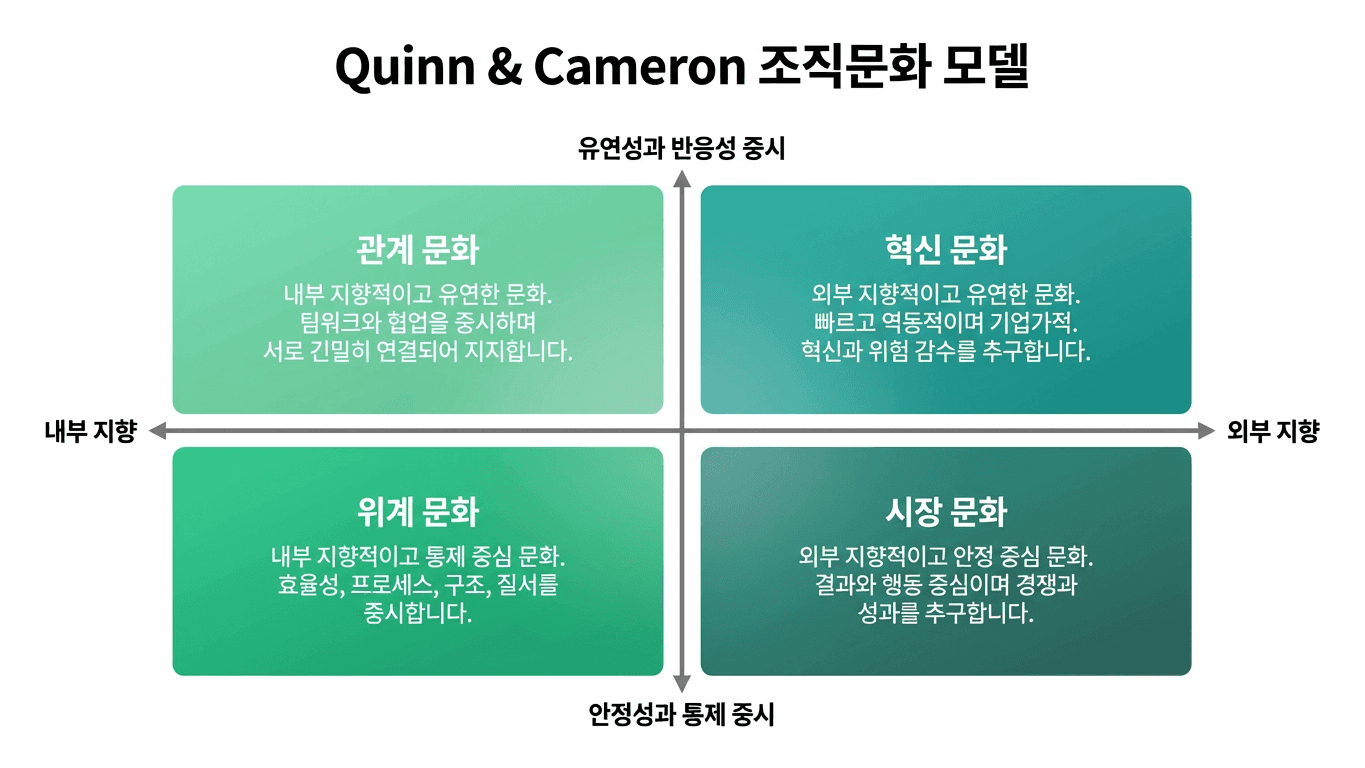
Assembling top individuals doesn't make a team. This article outlines how to design a small but solid team using three principles—role design, execution autonomy, and communication structure—along with the Quinn and Cameron organizational growth model.
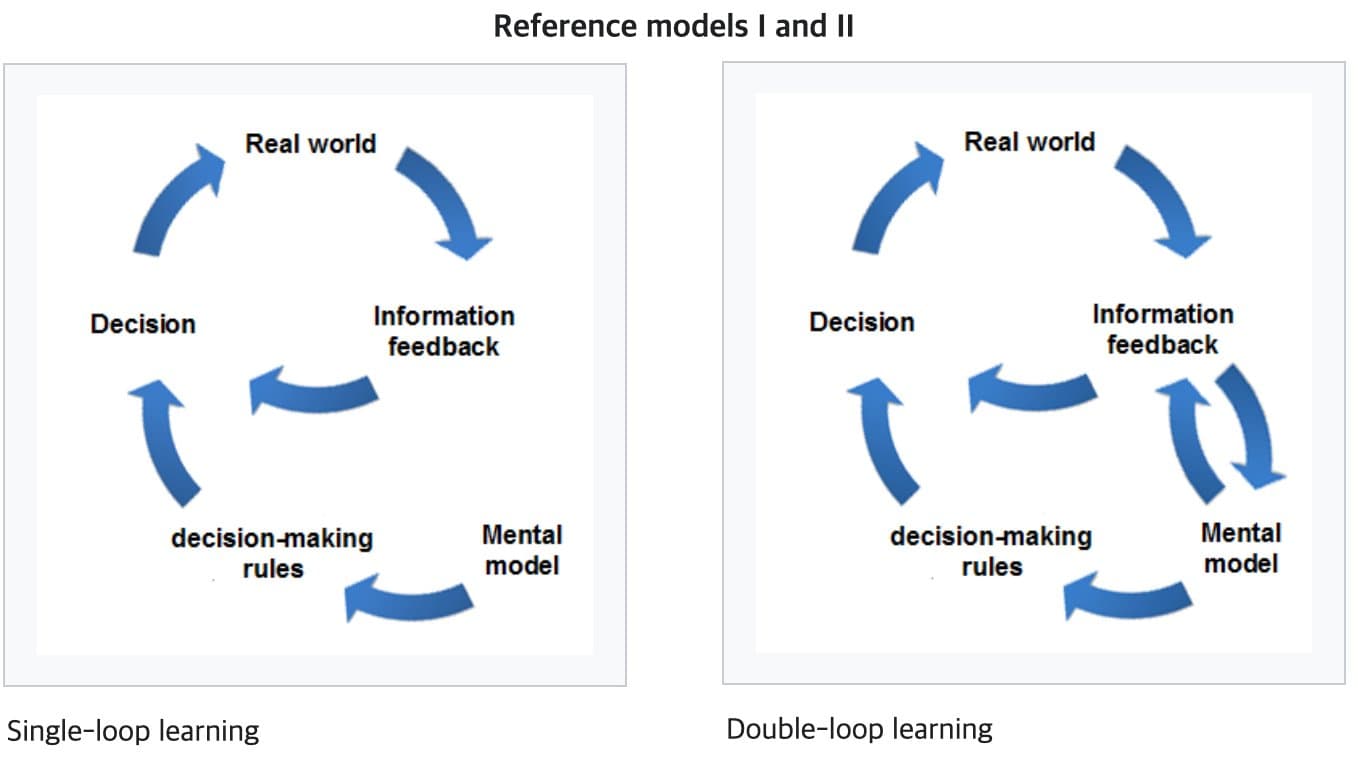
Of Google's countless projects, only about 50% succeed. The company even runs a unique space called 'The Google Cemetery' that displays tombstones of discontinued services. Google dissects these failures like autopsying a body, identifying direct and indirect causes of problems, documenting them precisely, and establishing countermeasures.

Open innovation is a paradigm where companies must intentionally bring in external ideas and technologies, share internal assets with the outside world, and create value to survive and grow. In other words, it's about breaking down organizational boundaries and increasing the probability of innovation through active external engagement—clearly demonstrating why 'absorptive capacity' is a core competitive advantage for modern startups.
CODEX 16. Market entry is not luck—it's a designed path: GTM Strategy
Even with a great product, you can't reach customers without a market entry path. Using the Figma case and the WHO-WHAT-HOW TO-GOAL framework, we've outlined how startups can design a GTM strategy to create their first 100 fans and establish themselves in the market.
Once a product (MVP) is complete, many founders immediately jump into the market. Like actors stepping on stage without a script, they start improvising with passion alone. But the market's response is usually cold. No matter how outstanding a product is, if who you'll reach, what you'll deliver, and how you'll deliver it aren't designed, you can't capture customer attention.
GTM (Go-to-Market) strategy handles precisely this design. It's a comprehensive execution blueprint that aligns every touchpoint—from the first moment a product meets customers through relationship building and value delivery—into a single coherent flow.
GTM strategy is not a simple marketing plan. It's a comprehensive execution blueprint that aligns all customer touchpoints—advertising, sales, channels, communication, onboarding—into one unified flow. If PMF proves a product's reason to exist, GTM proves the path for that product to successfully establish itself in the market.
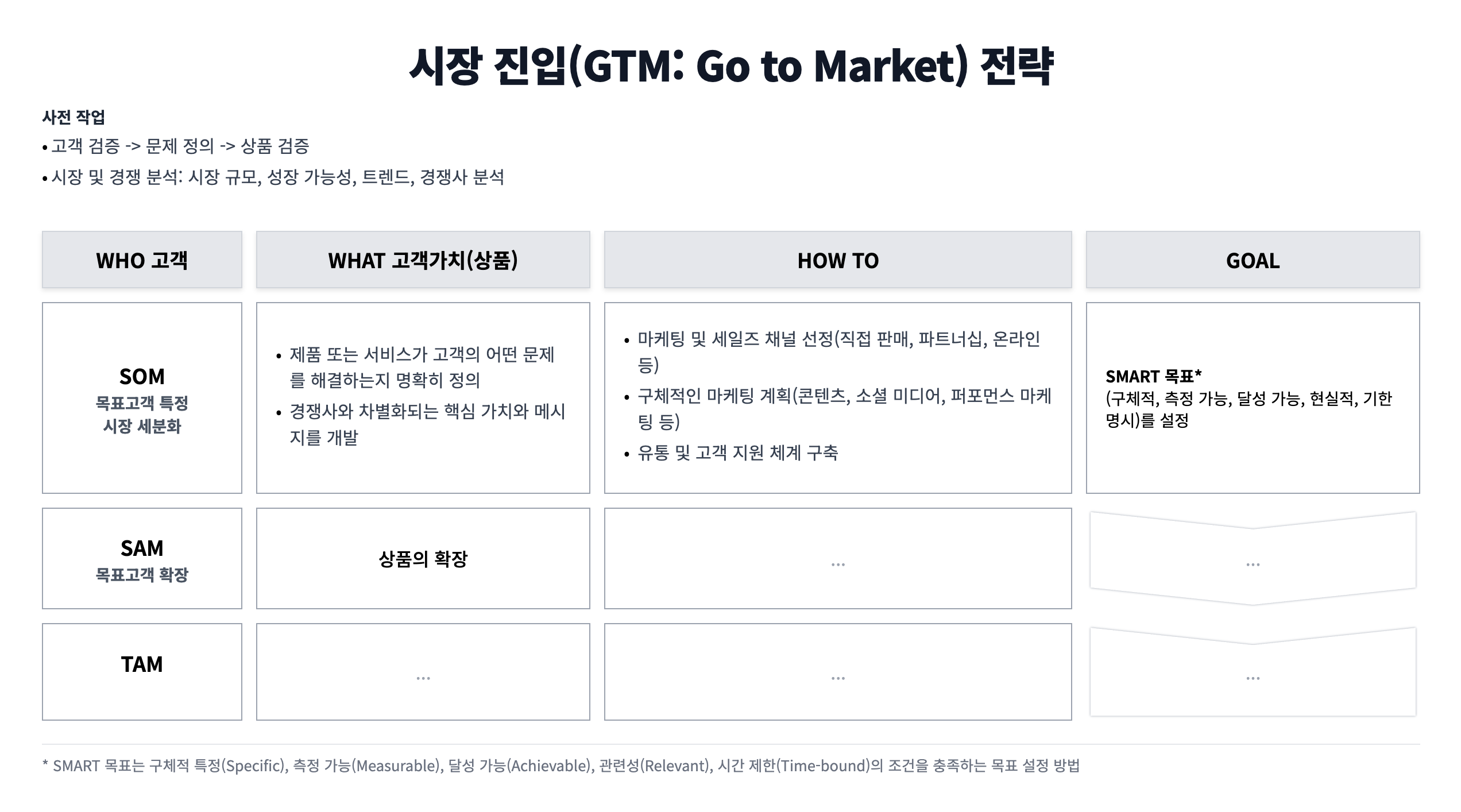
WHO — Who will you sell to?
Who is the core customer segment (SOM) that most urgently needs our product? Define demographics, psychographics, and most importantly, what problems they're experiencing.
WHAT — What will you sell?
Not a list of features, but a one-sentence summary of how you'll solve the customer's problem and what differentiated value you'll provide. This is your Unique Value Proposition.
HOW TO — How will you sell it?
Design the entire journey from the moment customers first become aware of you through purchase, retention, and referral. Determine what channels, content, and sales activities you'll use to interact with customers at each stage.
GOAL — What will you measure?
Rather than vague revenue growth, set specific, measurable objectives (KPIs) like "Within 3 months, in this specific channel, for this specific customer group, we'll achieve X% conversion rate."
A startup's GTM must be fundamentally different from that of a large corporation. Rather than a strategy that attacks all channels simultaneously with massive capital, you need a strategy that starts in a narrow market where the most enthusiastic customers gather and expands through word of mouth.
In early market entry, the most important thing isn't 'high traffic.' It's creating 100 fans who, after using our product, are convinced and actively recommend it to others. They become the best channel—and product evangelists (Advocates)—spreading our product without ad spend.
Focus and experimentation are key. Not broadcasting widely, but drilling narrow and deep. That's the essence of startup GTM.
In the design tool market dominated by the giant Adobe, Figma executed the following GTM strategy.
WHO. Figma didn't target 'all designers.' Instead, they focused exclusively on a very narrow, clear customer: 'designers at tech startups who collaborate in teams and need rapid prototyping.'
WHAT. Instead of promising "more features," they delivered a single powerful value: "real-time collaborative experience where multiple people work simultaneously in a browser." They competed on quality of problem-solving, not quantity of features.
HOW TO. Instead of large-scale advertising, they acquired early users through designer communities and influencers. The key was an intrinsic viral structure. When one designer started using Figma, they naturally had to invite colleague developers and product managers for collaboration. They designed into the product itself a structure where users bring users.
GOAL. Early on, Figma tracked 'team conversion rate' and 'new user rate through invitations' as core metrics rather than signup numbers. They verified with numbers whether the viral structure actually worked.
Without a massive advertising budget, Figma changed the market dynamics by finding the 100 most enthusiastic customers and turning them into evangelists.
Stage 1. WHO — Define your core customer
Rather than broadcasting messages to an undefined mass, strategically select the early customers who will respond first to your product. These aren't mere consumers—they should become co-builders who provide product feedback and help improve the product together. Define narrow and deep around the problem context, like "a marketer who reports on ad performance three times a week and struggles with data sharing across teams," not just "marketer."
Stage 2. WHAT — Craft your core value proposition in one sentence
Don't list features; pinpoint the customer's pain precisely and promise the single overwhelming value your product will deliver. Customers don't buy feature lists—they buy the outcome of their problem being solved. Complete the sentence: "We solve your [specific problem] in [specific way]," not "Our product has features A, B, C."
Stage 3. HOW TO — Design the entire customer journey as one flow
Don't just pick advertising channels; create the entire journey from the moment customers first become aware of you through experiencing value and becoming fans as a seamless flow. Each stage must naturally connect: Awareness (blog, content) → Understanding (free resources, webinars) → Trial (demo, free trial) → Conversion (payment) → Retention (onboarding, community) → Referral (referral program). If the flow breaks at any stage, all investment in prior stages is wasted.
Stage 4. GOAL — Define success in measurable numbers
Complete a verifiable sentence: "Within 3 months, to [this customer], with [this message], in [this channel], we'll create [this much conversion]." Prove whether your GTM strategy works with specific KPIs—conversion rate, active users, paid conversion rate, referral rate—not vague 'good responses.'
The essence of GTM strategy is creating a system for the entire path from the first moment our product meets customers through building relationships, delivering value, and leading to repeat purchases and referrals. Not leaving the start to luck, but making it a designed entry. That's the true starting point of growth.
Ultimately, products that survive in the market aren't the best products—they're the products with the best-designed paths.
Feedback loop that questions your thinking
Q1. Is our GTM strategy focused on 'traffic numbers' or designing 'conversion flow'?
Q2. Are we advertising to an undefined mass, or finding 100 fans who will passionately support us?
Q3. Is our GTM plan a blueprint with all four elements—WHO-WHAT-HOW TO-GOAL—or just a simple to-do list?
Q4. Is the success criterion 'how many people saw it' or 'how many people took action'?
[Startup Codex 22]
This content was created with permission from Brunch writer jaha Kim.