Products that truly sell are driven by necessity, not features
6 min read
Related articles
BD Insights
How to Build a Small but Strong Team
Gathering the best individuals doesn't make a team. This article outlines how to design a small but solid team using three principles—role design, execution autonomy, and communication structure—along with Quinn and Cameron's organizational growth model.
Aug 31, 2026
4 min read
BD Insights
Fleet Learning: Building Problem-Solving Capability as an Organizational Competency
Among Google's countless projects, the success rate is only around 50%. They even operate a unique space called 'The Google Cemetery,' which displays the tombstones of discontinued services. Google autopsies these failures, identifying direct and indirect causes of problems, accurately recording them, and establishing countermeasures.
Aug 21, 20266 min read
BD Insights
The Process of Turning Opportunity into Organizational Capability
Open innovation is a paradigm that demands companies intentionally bring external ideas and technologies inside, share internal assets with the outside, and create value in order to survive and grow. In other words, it means breaking down organizational boundaries and raising the odds of innovation through active external interaction—and this clearly shows why 'absorptive capacity' is a core competitive advantage for modern startups.
If customers don't feel the necessity (Essentiality)—the reason they must buy right now—your product is just one option among many, never a 'must-sell' product.
Is your product a vitamin or a painkiller? Vitamins are good for health, but skipping them today won't hurt. But when a severe headache strikes, a painkiller isn't a choice—it's a matter of survival. Products that truly sell are like the one painkiller that relieves extreme pain.
Customers browse lists of 'nice-to-have' products, but they spend money on 'must-have' ones. Our role isn't to create another nice vitamin, but to design the only painkiller for the customer's most painful problem.
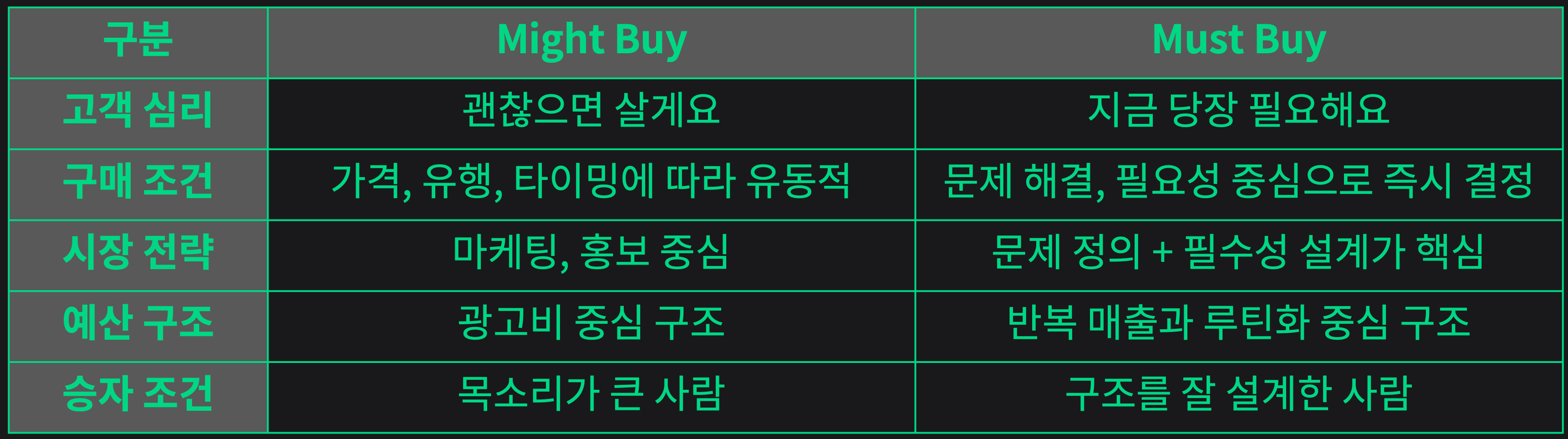
Might Buy vs. Must Buy Products
Whether your product is a vitamin or a painkiller determines your business's fate entirely.
Might Buy Products (vitamins) are items customers might purchase, but the decision is easily delayed or canceled depending on conditions like price, substitutes, or perceived need. To sell these, your marketing must shout, "Buy now!"
Must Buy Products (painkillers) are a matter of necessity where customers have no choice. They must buy, or the pain continues. These products require less marketing spend because necessity is built into their structure—customers come looking.
For startups, designing a 'Must Buy' structure by diving deep into customer problems is far more stable and sustainable than a 'Might Buy' strategy pushed by ad budgets.
The Psychology of Necessity
Humans are twice as sensitive to the pain of loss as to the joy of gain
Why do we postpone buying vitamins but purchase painkillers immediately? Prospect Theory by Daniel Kahneman, founder of behavioral economics, provides the answer.
The core of this theory is 'Loss Aversion'—humans feel the pain of losing something about twice as intensely as the pleasure of gaining something.
'Vitamins' offer a 'gain'—the promise of better health. Attractive, but delaying the purchase doesn't mean losing anything right now. But 'painkillers' stop a current 'loss'—the ongoing loss of health and time. Because loss aversion is such a powerful instinct, customers want to solve the problem 'right now,' not 'later.'
Ultimately, designing a 'must-sell product' is the process of positioning our solution not as a vague benefit, but as an urgent task that prevents clear loss.
Five Design Principles for 'Must-Sell Products'
What makes a product feel 'essential' to customers? This necessity is most powerful when it solves a clear 'pain,' like a painkiller stopping a headache.
But there's another equally powerful form of necessity. When everyone around you uses something and it becomes the 'social standard,' the feeling of being 'left out' or 'falling behind' by not using it creates necessity. The moment you think, "Everyone uses this—would it be weird if I don't?" that product becomes another kind of essential.
What matters is that whether solving functional pain or social isolation, this necessity never happens by accident. The product's very 'reason to exist' must be carefully designed into the customer's perception.
First, clear customer definition. Instead of saying "This product is for everyone," you must be able to say, "This is the only solution for Group B experiencing Problem A."
Second, recognized problems. The problem we're solving must be felt by customers as concrete 'pain'—discomfort, anxiety, or deprivation—in their daily lives.
Third, positioning as the go-to solution. At the moment of pain, before comparing alternatives, customers should think "Oh, that one!" and recall our product first—it must be imprinted in their minds.
Fourth, irresistible reasons to buy. Through features, emotions, or social value, provide justification so customers feel "Not buying this at this price would be a loss," enabling them to rationalize the purchase.
Fifth, structure for repeated, habitual use. Beyond a one-time purchase, the product must naturally integrate into customers' daily routines or workflows, establishing the habit of "I can't do without this."
When these five conditions are met, the product transcends a mere collection of features and becomes imprinted in customers' minds as 'something they can't do without.'
How Toss Became a Money Transfer Painkiller, Not Just a Finance App
When Toss first appeared, the market already had countless banking apps. If Toss had entered the market as "a convenient finance app with more features (vitamin)," it would never have succeeded.
Toss focused on one single, but extremely painful Pain Point: 'the tedious account transfers requiring public certificates and security cards.' Every Korean citizen suffered from this problem at the time.
Toss clearly positioned itself as a 'money transfer painkiller' solving this problem. Their message wasn't "We've included all financial services." It was a single message: "Now, send money easily and quickly without the annoying public certificate."
Toss chose to become the go-to solution in the very narrow, clear category of 'simple money transfers,' not the vast market of 'finance apps.' By perfectly solving the single most painful problem, customers began to see Toss as an 'essential app,' which became the solid foundation for growing into a financial super app.
Positioning Strategy for Startups
How can capital-strapped startups become the 'go-to solution' for a specific problem—the painkiller? The answer lies in narrowing the market.
Step 1. Find the patients in the most pain
Focus on the extreme pain of a few, not the shallow itch of many. The narrower and clearer the user context—like "nutritional drinks exclusively for mothers within 6 months postpartum"—the more urgent our solution becomes.
Step 2. Position as the only prescription
Deliver a clear message: "For this problem, we solve it best." Focus on results over features, like "the only choice that settles your stomach," linking the problem and your product 1:1 in the customer's mind.
Step 3. Clearly imprint the dosage instructions
Show customers a clear scene of when and where to think of your product. Like "Always OOO on your morning commute" or "OOO is standard after meals," insert your product into their recurring life moments.
The product that comes to mind first at the clearest moment dominates the market, not the one with the most ads. No need to despair over lack of budget. A narrow market, clear problem, and sharp message are sharper weapons than capital.
[This content was created with permission from Brunch author jaha Kim, utilizing [Startup Codex 22] content.]
To explore more content by jaha Kim, visit the link below.